


Key Takeaways
Can seeing a psychiatrist online really work as well as going to an office in person? Can regular mental health treatment actually prevent serious crises? New research now gives us clear answers to these important questions.
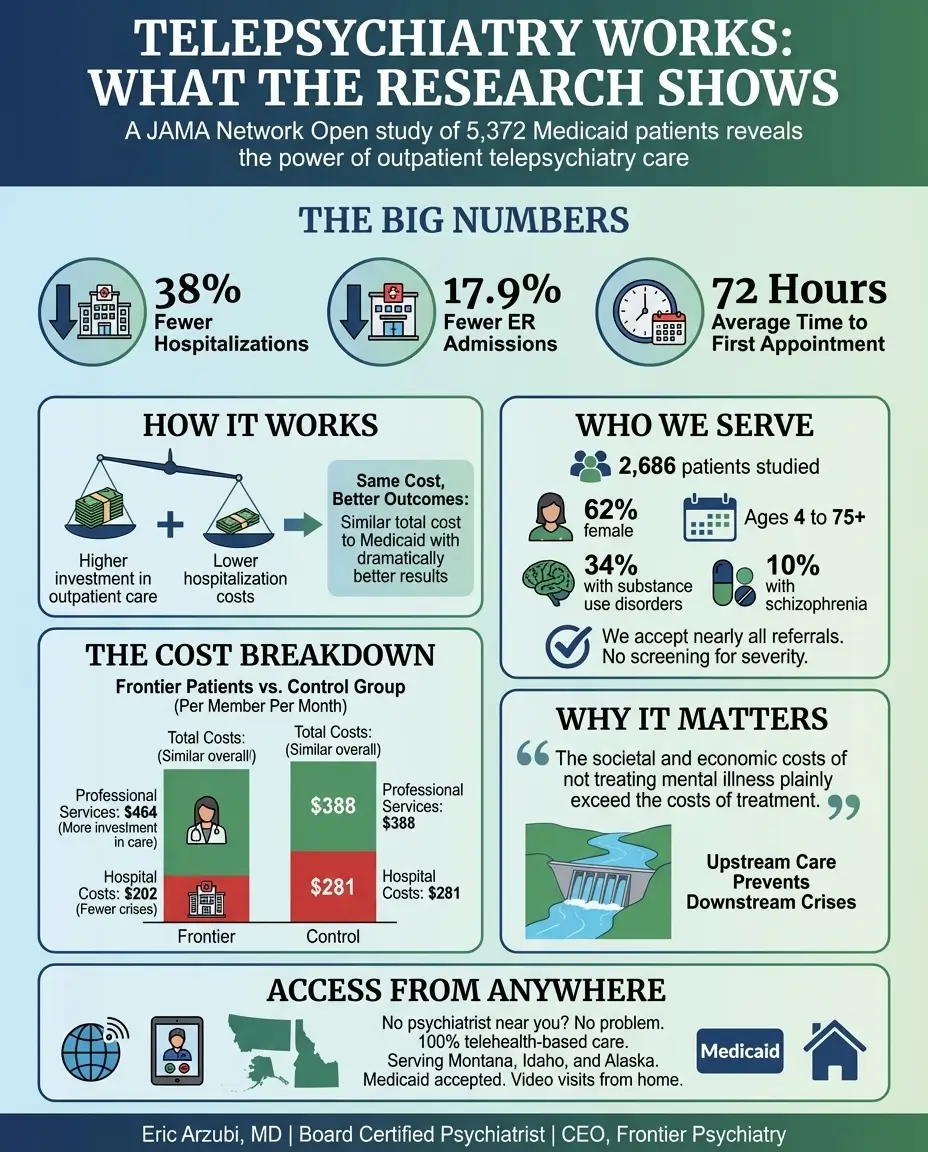
A study published in JAMA Network Open in May 2025 looked at outcomes for over 5,300 Medicaid patients. The researchers found that patients receiving care through Frontier Psychiatry's online psychiatric services had 38% fewer hospitalizations and 17.9% fewer emergency room admissions compared to similar patients not receiving these services. And here's the surprising part: the total cost to Medicaid was about the same for both groups.
These findings matter a lot for anyone wondering about psychiatry options for people in rural areas or asking "what if there are no psychiatrists near me?" Let's look at what this research means and how it might change the way you think about getting mental health care.
The Rural Mental Health Crisis: Why This Research Matters
Getting mental health care remains one of the biggest challenges in American healthcare. This is especially true in rural communities. The study authors point out several problems: psychiatrists are hard to find in most areas, most psychiatrists don't accept Medicaid, and those who do often have long wait times.
Montana, where Frontier Psychiatry is based, has historically had poor mental health outcomes. The state covers a huge area with a small population and very few mental health specialists. Many residents have been left wondering: "How do I see a psychiatrist online when there's no one in my town?"
This is exactly the problem that Frontier Psychiatry was built to solve. By providing 100% telehealth-based psychiatric care across Montana, Idaho, and Alaska, the clinic reaches patients who might otherwise get no treatment at all.
What the JAMA Network Open Study Found
The study was led by Dr. John L. Havlik of Stanford University. Dr. Reza Ghomi and Dr. Eric Arzubi of Frontier Psychiatry were co-authors. The researchers looked at 2022 Medicaid data. They compared 2,686 patients receiving care through Frontier Psychiatry to 2,686 similar patients who were not using the clinic's services.
Key Findings
Hospitalization rates dropped a lot. Patients using Frontier Psychiatry's services had a hospitalization rate of 274.3 per 1,000 patients per year. The comparison group had a rate of 442.6 per 1,000. That's a 38% reduction. This suggests that getting regular outpatient psychiatric care helps prevent the crises that lead to hospital stays.
Emergency room admissions went down. Among patients who did end up in the hospital, those getting care through the telepsychiatry clinic were 17.9% less likely to have been admitted through the emergency room (47.7% vs. 58.1%). This shows that their care was more planned and less driven by crisis.
Total costs stayed about the same. Frontier Psychiatry patients did have higher costs for professional services (the actual psychiatric care). But this was balanced out by lower costs for hospital stays. Hospital costs were $201.6 per member per month for telepsychiatry patients versus $280.9 for the comparison group.
The clinic treats complex patients. Frontier Psychiatry patients actually had higher rates of schizophrenia (9.7% vs. 6.3%) than the comparison group. This shows that the clinic doesn't just take easy cases. The organization accepts almost all patients with behavioral health concerns, from schizophrenia to substance use disorders, without screening based on how severe their illness is.
I'm Struggling With Mood Swings: Who Should I Talk To?
If you're having mood swings, racing thoughts, ongoing sadness, or anxiety that gets in the way of daily life, talking to a psychiatrist can help. A psychiatrist can figure out what's happening and what treatments might work for you.
Psychiatrists are medical doctors who specialize in mental health. Unlike therapists or counselors, psychiatrists can diagnose mental health conditions, prescribe and manage medications, and create complete treatment plans that may include both medication and therapy.
The Frontier Psychiatry study is important here. Patients in the study had many different diagnoses, including depression, anxiety, bipolar disorder, and schizophrenia. The 38% drop in hospitalizations suggests that connecting with psychiatric care early, before symptoms get worse, can make a real difference in outcomes.
Mood swings can be symptoms of several conditions. These include bipolar disorder, depression, anxiety disorders, or hormonal conditions. A psychiatrist can help figure out which condition you might have and recommend the right treatment.
When Is It Time to Consider Medication for Mental Health?
One of the most common questions people ask is when medication becomes necessary for mental health. The JAMA Network Open research helps answer this. Patients receiving care through Frontier Psychiatry had higher costs for professional services, which includes medication management. Yet they achieved much better outcomes when it came to avoiding hospitalizations and emergency room visits.
In general, medication should be considered when:
- Symptoms make it hard to work, keep relationships, or take care of yourself
- Therapy alone hasn't helped enough
- You have symptoms of conditions that respond well to medication, such as bipolar disorder, schizophrenia, severe depression, or certain anxiety disorders
- You're in crisis or at risk of hurting yourself or others
The study's findings support what psychiatrists have known for a long time: timely, evidence-based psychiatric care, which often includes medication, can prevent bigger problems down the road. The authors note that "the societal and economic costs of not treating mental illness plainly exceed the costs of treatment."
At Frontier Psychiatry, providers use proven treatment methods, including both therapy techniques and medications. The goal is to match each patient with the right combination of treatments for their specific situation.
How Do I See a Psychiatrist Online?
Telehealth psychiatry, sometimes called telepsychiatry, lets you meet with a psychiatrist through secure video visits. You can do this from your home, your office, or anywhere with internet access. This approach removes many of the usual barriers to care. There are no long drives to faraway cities, no taking full days off work, and no struggling with transportation or childcare.
The JAMA Network Open study looked specifically at an outpatient telepsychiatry clinic that provides 100% telehealth-based care. The strong outcomes (fewer hospitalizations, fewer emergency room visits, similar total costs) show that online psychiatric care can work very well.
To see a psychiatrist online through Frontier Psychiatry:
- Request an appointment through the clinic's website or by phone
- Complete intake paperwork about your history and current concerns
- Attend your video visit from any private location with good internet
- Receive ongoing care with follow-up appointments as needed
One important thing about Frontier Psychiatry's approach: the clinic can often see patients within 72 hours of their first request. This is much faster than the weeks or months many patients wait for regular psychiatric appointments.
What's the Difference Between a Child Psychiatrist and a Therapist?
Understanding the difference between mental health providers helps families make good choices about care.
Psychiatrists are medical doctors (MD or DO) who went to medical school, completed a psychiatry residency, and (for those who specialize in children) did extra training in child and adolescent psychiatry. They can diagnose mental health conditions, prescribe medications, order and read lab tests, and work with other medical providers. Child psychiatrists specifically understand how children develop, school challenges, and how mental health conditions look different in young people.
Therapists (including licensed clinical social workers, licensed professional counselors, and psychologists) provide talk therapy and counseling. They help patients build coping skills, work through emotions, and change unhelpful thinking patterns. Most therapists cannot prescribe medication.
Many patients do best with both: a psychiatrist managing medication and a therapist providing regular counseling. In the Frontier Psychiatry model, psychiatric providers can work together with therapists in a patient's community for complete care.
Can Children See a Psychiatrist Through Telehealth?
Yes, they can. The JAMA Network Open study included patients from young children to older adults. The data showed patients in the 4-11 and 12-17 age groups receiving care through the telepsychiatry clinic.
Telehealth can actually work especially well for children and teenagers. They often feel more comfortable at home. Parents can more easily join appointments. And there's no need to pull kids out of school for long trips to see faraway specialists.
For families in rural areas where child psychiatrists may be hours away or don't exist at all, telepsychiatry provides access that wouldn't be possible otherwise. Frontier Psychiatry serves patients across Montana, Idaho, and Alaska. These are regions where pediatric psychiatric specialists are especially rare.
Do I Need a Referral to See a Psychiatrist?
Requirements depend on your insurance plan, but many patients can get psychiatric care without a referral. Frontier Psychiatry accepts almost all patients with behavioral health concerns and does not screen patients based on how severe their condition is before accepting them.
If you have Medicaid, the JAMA Network Open study is especially relevant. It shows that Medicaid patients receiving telepsychiatry care had outcomes as good as or better than other patients. Frontier Psychiatry actively serves Medicaid patients. This is something many private practice psychiatrists do not do.
Steps to find out if you need a referral:
- Check your insurance plan documents or call your insurance company
- Many plans allow "self-referral" to mental health specialists
- If a referral is needed, your primary care doctor can usually provide one quickly
- Frontier Psychiatry's intake team can help you figure out insurance requirements
Do I Need Rehab or Can Addiction Be Treated Outpatient?
Substance use disorders come in different levels of severity, and treatment intensity should match how severe the condition is. The JAMA Network Open study included patients with substance use disorders (34.4% of the telepsychiatry group had a substance use disorder diagnosis). This shows that outpatient psychiatric care can effectively help this population.
Outpatient treatment may be right for you when:
- You have a stable place to live
- You don't need medical supervision for detox
- You have some support from family or friends
- Your addiction hasn't caused severe medical problems
- You can stay safe between appointments
Inpatient or residential treatment may be needed when:
- You need medical supervision for withdrawal symptoms
- Outpatient treatment hasn't worked for you
- Your living situation makes recovery difficult
- You have other conditions that need intensive care
- You're at risk of harming yourself or others
The study's finding that outpatient telepsychiatry patients had 38% fewer hospitalizations suggests that good outpatient care, including medication management for substance use disorders, can help many patients avoid more intensive treatment.
Psychiatry Options for People in Rural Areas
The JAMA Network Open study directly addresses one of the biggest healthcare challenges in America: how to provide psychiatric care to people who live far from specialists.
Traditional psychiatry requires patients to travel to a psychiatrist's office, which is usually in a city. For someone living in rural Montana, Idaho, or Alaska, this might mean a half-day or full-day trip for just one appointment. And that's if a psychiatrist is available at all.
Frontier Psychiatry's telepsychiatry model removes geography as a barrier. Patients connect by video from home. This eliminates travel time and the costs that come with it. The study shows this model works: patients receiving care had far fewer hospitalizations, even though (or maybe because) they received all their psychiatric care through telehealth.
The study's authors note that the clinic "fills a longstanding statewide gap in upstream care access" for patients in a state with historically poor mental health outcomes. This upstream approach, treating patients before crises happen, seems to be the key to the better outcomes shown in the research.
What If There Are No Psychiatrists Near Me?
This may be the most important question the JAMA Network Open study helps answer: you don't need a psychiatrist near you to get high-quality psychiatric care.
The research shows that patients receiving 100% telehealth-based psychiatric care through Frontier Psychiatry had better outcomes than similar patients on important measures:
- 38% fewer hospitalizations
- 17.9% fewer emergency room admissions
- Similar total healthcare costs
If you're in Montana, Idaho, or Alaska, Frontier Psychiatry can provide care no matter how far you are from a major city. The clinic's ability to see patients within 72 hours of first contact means you're not waiting months while symptoms get worse.
For those outside Frontier Psychiatry's service area, the study shows that telepsychiatry in general, not just in-person care, can deliver excellent results. When looking for telepsychiatry options, look for providers who:
- Accept your insurance (including Medicaid)
- Don't turn away complex cases
- Offer appointments quickly
- Provide evidence-based treatments
The Bigger Picture: Investing in Upstream Care
The JAMA Network Open study makes a strong case that investing in outpatient psychiatric care reduces costs later on and improves patient outcomes. Higher spending on professional services (actual psychiatric treatment) was balanced out by lower spending on hospitalizations. The result was similar total costs but much better quality measures.
The study's authors conclude: "Further government and private investment is needed to reduce downstream sequelae of delayed psychiatric care. It is our hope that the findings we report here spur increased investment in, and access to, pragmatic and timely outpatient psychiatric treatment for some of our nation's most vulnerable patients."
For individuals and families, the message is clear: getting connected with psychiatric care early matters. Whether you're dealing with mood swings, wondering if medication might help, or facing a shortage of local providers, evidence now supports that telepsychiatry can deliver the timely, effective care that prevents crises.
Take the Next Step
If you're in Montana, Idaho, or Alaska and need psychiatric care, Frontier Psychiatry offers appointments, often within 72 hours, no matter where you live. The clinic accepts most insurance plans, including Medicaid, and serves patients with all types of behavioral health conditions.
For those wondering "what if there are no psychiatrists near me?" this research suggests the answer may be closer than you think. Your next psychiatric appointment could happen from your living room.
Frontier Psychiatry is one of the largest psychiatric care organizations in the Intermountain West. We provide evidence-based outpatient telepsychiatry care across Montana, Idaho, and Alaska. Our research, published in JAMA Network Open, shows our commitment to improving outcomes for patients, including the most vulnerable, through accessible, timely psychiatric care.
Reference: Havlik JL, Ghomi RH, An N, Budhiraja P, Arzubi ER. Medicaid Costs and Outcomes for Patients Treated in an Outpatient Telepsychiatry Clinic. JAMA Netw Open. 2025;8(5):e258558. doi:10.1001/jamanetworkopen.2025.8558