

A psychiatrist's honest conversation about living with anxiety, the journey from Wall Street to rural mental health care, and why America's mental health system needs more than new treatments. It needs better access.
Key Takeaways
- Even psychiatrists struggle with anxiety. Getting help is a sign of strength, not weakness.
- Mood follows action. Taking small positive steps, even when you don't feel like it, can help you feel better.
- Recognizing your early warning signs (sleep problems, racing thoughts, stomach knots) lets you act before things spiral.
- You don't have to travel hours for quality mental health care. Telehealth brings psychiatry to you.
- A great resume doesn't buy peace of mind. What matters is finding purpose, connection, and the right support.
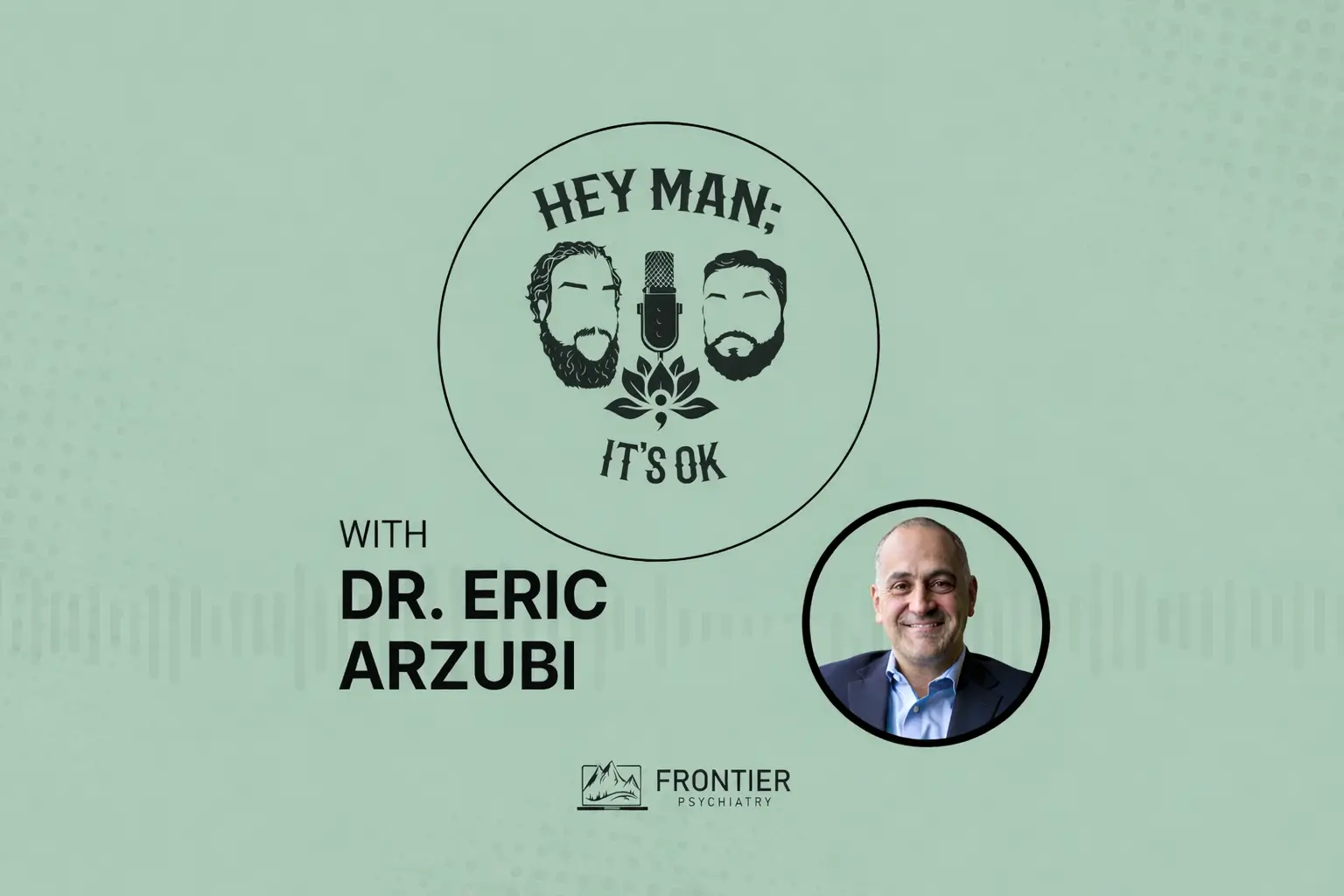
I recently joined Sky and Ryan on the Hey Man: It's OK podcast to talk about something most psychiatrists don't openly discuss: my own struggles with anxiety. From curling up in the fetal position during premed classes to building a telehealth practice serving rural communities across Montana, Alaska, Wyoming, and Idaho, I shared the real story behind Frontier Psychiatry, and why I believe we need to stop calling America's mental health problem a "crisis" and start treating it like what it actually is: a chronic, broken system.
The Conversation That Almost Didn't Happen
When the team at Hey Man: It's OK reached out to me through LinkedIn, I wasn't sure what to expect. Would they want me to talk about clinical topics? Statistics about rural mental health shortages? Instead, they wanted something different. They wanted to know about me, the person behind the credentials, the psychiatrist who also happens to be a patient.
That's a conversation I've learned to welcome over the years, even though it wasn't always easy.
During our nearly hour-long discussion, we covered everything from my unusual career path (three careers before settling on psychiatry at 56) to the practical tools I use to manage my own anxiety. We talked about marijuana's impact on developing brains, the hidden mental health struggles of male athletes, and why I tell my daughters that a great resume doesn't buy peace of mind.
But the part of our conversation that seemed to resonate most was when I talked about what it actually feels like to have severe anxiety, and why that experience has made me a better doctor.
From Bond Trading to Psychiatry: The Long Road
Most people don't know that I had two full careers before becoming a psychiatrist. I graduated from college in 1991 and started as a reporter for Bloomberg when they were still a relatively small operation. I was actually their first Latin American reporter. After two years of writing about what other people were doing in finance, I decided I wanted to do the doing myself.
That led me to Morgan Stanley, where I ended up as a bond trader in New York City. It was exciting work. I learned a ton about people and how the world operates. I was making good money, living in Manhattan, and by most external measures, doing well.
But something was missing. I felt deeply unfulfilled.
The only role model I kept thinking about was my childhood pediatrician from Vermont, Dr. Narkewicz. He was respected. He served his community. And I realized that if I wanted to be remembered for something meaningful, I needed to follow a different path.
That decision set me on a 14-year journey from Wall Street to my first full-time job as a psychiatrist in Montana. Along the way, something unexpected happened that would shape everything about how I practice medicine today.
When Anxiety Nearly Ended My Medical Dreams
About nine months into my premed classes at Columbia University, I hit a wall. And when I say hit a wall, I mean I discovered (or uncovered, or somehow triggered) massive anxiety.
Here's how I described it on the podcast:
"It was bad. It was bad enough where I more than once was curled up in a fetal position wondering if it would ever stop. I had my first encounter with mental health professionals at that point. I was 30 now. I met with a psychiatrist and just like a lot of patients when they come to me, when I was talking to the psychiatrist, I'm like, 'Listen, I just need to meet with you and talk to you a couple times. I don't need medications. I'll be fine.' And about a few weeks later, I was like begging him for medications. I'm like, 'I need help. I don't know what's going on. I feel crazy. I need help.'"
The spiral started with something that might seem small to an outsider: a bad grade in biology. After crushing my classes and getting straight A's, that one poor test result triggered a cascade of catastrophic thoughts. In my mind, I went from a bad biology test to being homeless and out of work in a matter of hours.
I remember sitting in one of Columbia's beautiful oak-paneled libraries, staring at a textbook page, and nothing was registering. I kept reading and rereading, getting more panicky, unable to focus or think. That night I tried to sleep and couldn't. By the next morning, things had spiraled further.
My body was forcing me to take a break. I had to pause my premed classes for six to nine months while I got treatment, medication and therapy, before I could resume my path toward medicine.
The Blessing and Burden of Lived Experience
That first major episode was the lowest I've ever been. But in the 26 years since then, I've had other dips, some of them pretty significant. I've always been terrified of going back to that dark place.
What I've learned over time is that I always bounce back. And knowing that, having that track record, gives me comfort when anxiety starts knocking on the door again.
As I told Sky and Ryan:
"One of the things that's given me some comfort when anxiety starts to rear its ugly head again is that I've always bounced back. A lot of people who experience anxiety know what I'm talking about, where it feels like it's never going to stop and it feels like it's never going to go away and it feels like it's going to get worse. And so having had that initial kind of experience and then a bunch of other nasty episodes in between, I bounce back. So when I do start to relapse and it starts to feel awful again, I feel awful, but then I'm like, 'Okay, I've been here before. I've bounced out of this before. Chances are pretty good it'll happen again.'"
I still take Lexapro. I still sometimes forget to take it when I'm feeling better (just like my patients do). I've learned to recognize my early warning signs: a random pit in my stomach, waking up early and not being able to fall back asleep, my mind starting to spin with worry.
When those signals appear, I have a checklist I run through: Am I taking my medications? Am I exercising regularly? I cut out alcohol because it affects my sleep, and poor sleep makes my anxiety worse. I use meditation apps. The key is behavioral activation: not waiting until you feel better to do something, but doing something hoping it'll make you feel better.
Mood follows action.
Why I Share My Story With Patients
Some psychiatrists might think it's unprofessional to discuss their own mental health struggles. I disagree.
Here's the thing: I've got the same problems everybody else does. None of us psychiatrists are immune to this stuff. If someone says they've never struggled, they're probably not telling you the truth.
"I do think having anxiety has made me a better clinician in some ways. It's strangely satisfying when I talk to a patient and they're telling me about their anxiety and I tell them, 'Let me guess, you're feeling this and this.' And they're like, 'Oh my god, Dr. Arzubi, how do you know?' Been there, done that."
I don't lead with my personal history. It's not like when a patient tells me they're anxious, I respond with, "You think you've got it bad? I'm more anxious." But I do try to use my experience in a way that's disarming. I don't want my patients thinking I'm somehow above their struggles, because I'm absolutely not.
The difference between me and my patients is simply that I've spent years building a toolbox I can apply to myself, and I'm trained to apply those same tools to help others. That's what makes psychiatrists useful. It's our job to think about these things.
We Don't Have a Mental Health Crisis. We Have a Broken System.
During the podcast, I made a statement that might surprise some people: I don't think we're in a mental health crisis anymore.
That's not because the problems aren't real or severe. It's because we've been calling this a "crisis" for over 25 years, and at some point, we need to acknowledge that a crisis that lasts a quarter-century isn't a crisis. It's a chronic problem. A chronically broken system.
"The surgeon general in 1999 issued a report saying, 'Oh, we got a mental health crisis.' And then the last surgeon general under Biden, he issued I think two reports expressing that we're having a mental health crisis again. And God bless both of those surgeon generals, but I'm like, it's been 25 years. It's not a crisis anymore."
Here's what I want people to understand: There's no white knight coming to fix this. There's no miracle drug that's going to solve everything. We already know how to treat depression. We know how to treat anxiety. We know how to treat schizophrenia. Is any of it perfect? No. But we're not even getting the basic, proven treatments to all the people who need them.
Cognitive behavioral therapy works for anxiety and depression. Does everyone have access to CBT? Not even close. Sixty percent of all SSRIs are prescribed by primary care doctors who are doing their best but aren't always in a position to ensure the right diagnosis or appropriate follow-up.
Instead of chasing shiny new treatments, we need to pause and deliver what actually works to the people who need it. That's the mission behind Frontier Psychiatry.
Bringing Care to Rural America
When I moved to Montana in 2013, I still had patients traveling four or five hours to see me for a 30-minute appointment. That reality drove me to build Frontier Psychiatry, a telehealth-based practice that brings psychiatric care to people in Montana, Alaska, Wyoming, and Idaho regardless of where they live.
People sometimes ask whether telehealth is really as effective as in-person care. My response: Don't compare telehealth to in-person. Compare telehealth to nothing, because nothing is what most people in rural America have access to.
Of course I'd rather sit face-to-face with my therapist on a couch. But that's simply not an option for millions of Americans. So we have to meet people where they are, using the technology available to us.
What I Hope You Take Away
If there's one thing I want people to understand from my conversation on Hey Man: It's OK, it's this: You can accomplish incredible things and still struggle with your mental health. A great resume doesn't buy you peace of mind. Credentials don't make you immune to anxiety, depression, or any other challenge.
What matters is building tools, seeking help when you need it, bouncing back when you fall down, and trying to make the world around you a little bit better.
That's what I tell my daughters. That's how I try to live my life. And that's why I do this work.
Listen to the full podcast episode
Ready to Talk to Someone Who Understands?
If you're struggling with anxiety, depression, or other mental health challenges, you don't have to do it alone. Frontier Psychiatry brings expert psychiatric care to you, wherever you are in Montana, Alaska, Wyoming, or Idaho.
Schedule your first appointment now.
Frequently Asked Questions
Can psychiatrists struggle with anxiety too?
Yes. Mental health professionals experience the same conditions they treat. Dr. Eric Arzubi openly shares his anxiety journey and uses his lived experience to connect with patients and provide more empathetic care.
What is behavioral activation and how does it help anxiety?
Behavioral activation means taking positive action without waiting to feel better first. The principle is that mood follows action. By engaging in healthy behaviors like exercise or social connection, people can improve their emotional state rather than waiting for motivation to strike.
Does telehealth work for psychiatric care?
Yes. For millions of rural Americans who have no access to psychiatrists, telehealth provides a vital lifeline that can deliver effective treatment where none would otherwise exist. Research shows telehealth psychiatry is effective for conditions like anxiety and depression.
What are early warning signs of an anxiety relapse?
Common early warning signs include sleep disruption (waking early and not falling back asleep), a random pit in your stomach, racing or worried thoughts, and difficulty concentrating. Recognizing these signs early allows you to take action before symptoms worsen.
What states does Frontier Psychiatry serve?
Frontier Psychiatry is a telehealth-based psychiatric practice that delivers mental health care to patients in Montana, Alaska, Wyoming, and Idaho, focusing on making high-quality psychiatric care available to rural and underserved communities.
How can I get started with Frontier Psychiatry?
Visit frontier.care and click Get Started to schedule your first telehealth appointment. Our team will match you with a provider who understands your needs and can deliver care wherever you are in Montana, Alaska, Wyoming, or Idaho.
---
Dr. Eric Arzubi is the CEO and Co-Founder of Frontier Psychiatry, a Yale-trained child psychiatrist, and author of "From Silence to Solutions." Connect with him on LinkedIn at @DrZoobs or learn more about Frontier Psychiatry at frontier.care.