



It's 5 AM in rural Montana. You're already awake, staring at the ceiling, dreading another day that feels exactly like the last hundred. Maybe you're a rancher who hasn't taken a real day off in three years. Maybe you're a healthcare worker driving 90 miles round-trip to your shift, then coming home to care for aging parents. Or maybe you're a parent in a remote Alaskan village, trying to hold everything together while feeling completely alone.
You're exhausted in a way that sleep doesn't fix. You've stopped enjoying things that used to bring you peace. And somewhere in the back of your mind, a voice keeps saying: "Everyone else handles this. Why can't I?"
Here's the truth: what you're experiencing might not be normal tiredness. It might be burnout. And in rural communities across Montana, Idaho, and Alaska, burnout has reached crisis levels that often go unrecognized and untreated.
This guide will help you understand what burnout actually is, recognize the warning signs in yourself and others, and take practical steps toward recovery. Whether you're struggling yourself or trying to figure out how to help someone with mental illness or exhaustion, you'll find actionable information here.
What Is Mental Burnout? (And How It Differs From Normal Stress)
Burnout is more than having a bad week or feeling tired after a busy season. It's a state of chronic physical, emotional, and mental exhaustion caused by prolonged stress that hasn't been successfully managed.
The World Health Organization officially recognizes burnout as an occupational phenomenon, but anyone can experience it. Parents, caregivers, students, and community members are all vulnerable.
Here's how to tell the difference between normal stress and burnout:
Normal stress usually connects to a specific situation. You feel overwhelmed by a deadline, worried about a sick animal, or anxious about finances. When the situation resolves, the stress typically eases. You can still find moments of joy and hope. Your body and mind recover with rest.
Burnout is different. It builds gradually over weeks, months, or years. The exhaustion becomes constant. You feel emotionally numb or detached from things you used to care about. Rest doesn't restore you. You might feel hopeless, cynical, or like you're just going through the motions. Your sense of accomplishment disappears, replaced by feelings of failure or inadequacy.
Mental exhaustion from burnout affects your entire system. You might notice memory problems, difficulty concentrating, frequent headaches, changes in appetite, or getting sick more often. Your fuse gets shorter. Small problems feel enormous.
Understanding how to help mental exhaustion starts with recognizing that burnout is a legitimate condition, not a character flaw or sign of weakness.
Why Rural Communities Face Unique Burnout Challenges
People living in rural Montana, Idaho, and Alaska face burnout risk factors that urban residents rarely encounter. This isn't about rural people being less resilient. It's about facing harder circumstances with fewer resources.
Geographic isolation creates both practical and emotional challenges. When your nearest neighbor is 20 miles away and the closest town with services is an hour's drive, you can't easily access the support systems that help prevent burnout. Grocery runs become half-day trips. Medical appointments require significant planning. The physical distance translates to emotional distance from potential support networks.
Limited local resources mean rural residents often fill multiple roles. You might be the only person available to care for elderly parents, run a family business, volunteer with the fire department, and help neighbors during emergencies. There's no one to hand responsibilities off to when you need a break.
Economic pressures in agriculture, mining, logging, and fishing create unpredictable stress. Weather, market prices, and equipment failures can threaten livelihoods overnight. Many rural families live with chronic financial uncertainty that compounds over time.
Caregiver burden falls heavily on rural community members. With limited access to professional home health services, assisted living facilities, or mental health providers, families handle caregiving duties that might be shared with professionals in urban areas.
Seasonal factors add another layer. Long, dark winters in Alaska and northern Montana can worsen isolation. Agricultural communities face intense seasonal demands that prevent recovery time. Wildfire seasons bring both physical danger and chronic stress.
Cultural expectations in rural communities often emphasize self-reliance and toughness. While these traits help people survive difficult conditions, they can also prevent people from seeking help when they need it. Admitting you're struggling can feel like admitting failure.
Early Warning Signs of Burnout
Burnout rarely arrives suddenly. It creeps up gradually, which makes it easy to dismiss early symptoms. Learning to recognize these warning signs in yourself and others can prevent a manageable situation from becoming a crisis.
Physical signs include chronic fatigue that sleep doesn't resolve, frequent headaches or muscle tension, changes in sleep patterns (sleeping too much or too little), getting sick more often, and changes in appetite or weight.
Emotional signs include feeling emotionally drained or empty, increased cynicism or negativity, loss of enjoyment in activities you used to love, feeling detached from others, and a sense of dread about daily responsibilities.
Behavioral signs include withdrawing from social activities, neglecting responsibilities, using alcohol or other substances to cope, snapping at family members, and decreased productivity despite working harder.
Cognitive signs include difficulty concentrating, forgetfulness, trouble making decisions, and constant worry or racing thoughts.
For people with ADHD, burnout can look different and hit harder. Understanding how to help ADHD burnout requires recognizing that executive function challenges make recovery strategies more difficult to implement. People with ADHD may experience burnout more intensely because they've been working overtime just to manage daily tasks that come easier to neurotypical individuals.
Practical Recovery Strategies That Actually Work
Recovery from burnout doesn't happen overnight, and it rarely happens through willpower alone. These strategies are designed for real people with real constraints, not for someone who can take a month off and go to a spa.
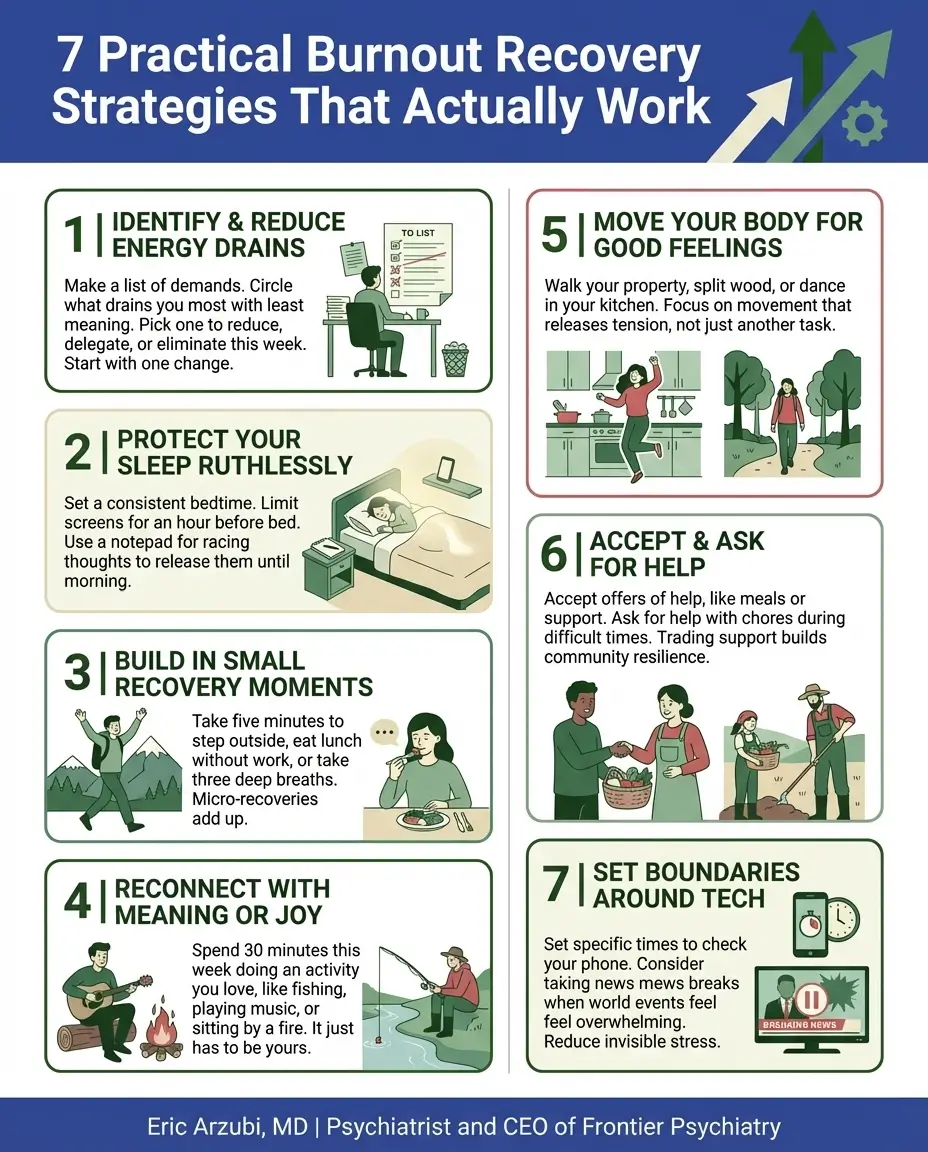
Strategy 1: Identify and reduce your biggest energy drains.
Make a list of everything demanding your energy right now. Circle the items that drain you most while providing the least meaning or necessity. Pick one thing from that list to reduce, delegate, or eliminate this week. You don't have to overhaul your entire life at once. Start with one change.
Strategy 2: Protect your sleep ruthlessly.
Sleep is when your brain clears stress hormones and consolidates memory. Chronic sleep deprivation makes everything harder. Set a consistent bedtime. Limit screens for an hour before bed. If racing thoughts keep you awake, try keeping a notepad by your bed to write them down and release them until morning.
Strategy 3: Build in small moments of recovery throughout your day.
You may not be able to take a vacation, but you can take five minutes to step outside and look at the mountains. You can eat lunch without working. You can take three deep breaths before getting out of your truck. These micro-recoveries add up.
Strategy 4: Reconnect with one source of meaning or joy.
Burnout often steals our connection to things we love. Think about an activity that used to bring you peace or happiness, whether that's fishing, working with horses, playing music, or sitting by a fire. Commit to spending 30 minutes doing that activity this week. It doesn't have to be productive. It just has to be yours.
Strategy 5: Move your body in ways that feel good.
Exercise helps regulate stress hormones and improve mood, but you don't need a gym membership or structured workout. Walk your property. Split wood. Dance in your kitchen. The goal is movement that releases tension rather than adding another task to your list.
Strategy 6: Accept help when it's offered (and ask for it when it's not).
Rural communities often have strong traditions of helping neighbors. Let that work for you. If someone offers to bring a meal, say yes. If you need help with chores during a difficult time, ask. Trading support builds community resilience and reminds you that you don't have to handle everything alone.
Strategy 7: Set boundaries around technology and news.
Constant connectivity, social media, and 24-hour news cycles add invisible stress. Try setting specific times to check your phone rather than keeping it in your hand all day. Consider taking news breaks when world events feel overwhelming.
How to Help Someone With Burnout or Mental Health Crisis
Watching someone you care about struggle with burnout or mental health challenges can feel helpless. Here's practical guidance on how to help someone with mental breakdown symptoms or chronic burnout.
Start with presence, not solutions. Often the most powerful thing you can do is simply be there. Say something like, "I've noticed you seem really exhausted lately. I'm here if you want to talk." Then listen without trying to fix anything immediately.
Offer specific help rather than general offers. Instead of "Let me know if you need anything," try "I'm going to town Tuesday. Can I pick up groceries for you?" Specific offers are easier to accept and don't require the burned-out person to figure out what they need.
Normalize seeking help. If you've ever worked with a counselor or psychiatrist, consider sharing your experience. Knowing someone they respect has sought mental health care can reduce stigma.
Watch for crisis signs. If someone expresses hopelessness, talks about being a burden to others, or mentions wanting to escape or not wanting to be alive, take it seriously. Stay with them, express concern directly, and help connect them to crisis resources or professional care.
Take care of yourself too. Learning how to help someone with mental illness is important, but you can't pour from an empty cup. Make sure you're maintaining your own wellbeing while supporting others.
When to Seek Professional Help
Self-care strategies are valuable, but sometimes burnout requires professional support. Consider reaching out to a mental health provider if:
You've been experiencing burnout symptoms for more than a few weeks without improvement. Your daily functioning is significantly impaired (missing work, unable to care for yourself or family). You're using alcohol, drugs, or other substances to cope. You're experiencing thoughts of self-harm or suicide. Anxiety or depression symptoms are present alongside burnout. Your relationships are suffering significantly.
There's no shame in needing professional help. Burnout is a medical condition that responds well to treatment. A psychiatrist or therapist can help you develop personalized strategies, identify underlying conditions that might be contributing (like depression, anxiety, or ADHD), and provide support as you recover.
How Telepsychiatry Makes Mental Health Care Accessible
For years, one of the biggest barriers to mental health care in rural communities has been simple geography. When the nearest psychiatrist is a four-hour drive away, getting help feels impossible.
Telepsychiatry changes that equation. Through secure video appointments, you can connect with experienced mental health providers from your home, your truck, or wherever you have internet access.
At Frontier Psychiatry, we've built our practice specifically around serving rural communities in Montana, Idaho, and Alaska. We understand the unique pressures you face because we've chosen to focus our work here. We know that your schedule might not fit traditional office hours. We know that driving hours for an appointment isn't realistic when you have livestock to feed or shifts to cover.
Our services don't require a referral from another provider. You can reach out directly when you're ready. We offer psychiatric evaluation, medication management, and ongoing support for conditions including depression, anxiety, ADHD, PTSD, and burnout.
Our research, published in JAMA Network Open, shows that patients who receive care through our practice experience significantly lower hospitalization rates and fewer emergency room visits compared to standard care. Accessible, consistent mental health support works.
Frequently Asked Questions
What's the difference between burnout and depression?
Burnout and depression share symptoms like exhaustion, hopelessness, and loss of interest in activities. The main difference is that burnout typically connects to specific life demands and improves when those demands decrease. Depression is a clinical condition that persists regardless of circumstances. However, untreated burnout can develop into depression, and many people experience both simultaneously. A mental health provider can help distinguish between them and recommend appropriate treatment.
How long does it take to recover from burnout?
Recovery time varies depending on how severe the burnout is and what changes you're able to make. Some people notice improvement within a few weeks of implementing recovery strategies. Others need several months, especially if burnout has been building for years. Professional support can speed recovery and help prevent recurrence.
Can burnout cause physical health problems?
Yes. Chronic stress from burnout affects your immune system, cardiovascular health, and hormonal balance. People experiencing burnout get sick more often, have higher rates of heart disease, and may develop chronic pain conditions. Addressing burnout protects both mental and physical health.
How do I know if I have ADHD burnout versus regular burnout?
ADHD burnout often follows periods of "masking" where you've been working extra hard to appear neurotypical or meet expectations that don't account for ADHD challenges. It may include complete executive function collapse, rejection sensitive dysphoria, and intense shame. If you suspect ADHD might be contributing to your burnout, evaluation by a psychiatrist can clarify the picture and open treatment options.
Is telepsychiatry as effective as in-person care?
Research consistently shows that telepsychiatry is as effective as in-person care for most conditions. For rural residents, it's often more effective in practice because it removes barriers that prevent people from accessing care at all. You're more likely to attend appointments, follow through with treatment, and get help during crisis moments when care is accessible from home.
Key Takeaways
- Burnout is not normal tiredness. It's chronic physical, emotional, and mental exhaustion that doesn't improve with rest and requires intentional intervention.
- Rural communities face unique burnout risks including geographic isolation, limited resources, multiple caregiving roles, economic uncertainty, and cultural pressure to be self-reliant.
- Early warning signs include constant fatigue, emotional numbness, withdrawal from activities you once enjoyed, difficulty concentrating, and increased irritability or cynicism.
- Recovery starts with small, sustainable changes: protecting sleep, identifying energy drains, building micro-recovery moments into your day, and reconnecting with sources of meaning and joy.
- If you're helping someone with burnout, offer specific support, listen without trying to fix, and watch for signs of crisis that require professional intervention.
- Professional help is appropriate when symptoms persist for weeks, daily functioning is impaired, substances are being used to cope, or thoughts of self-harm arise.
- Telepsychiatry removes the geographic barriers that have historically prevented rural residents from accessing mental health care. Quality treatment is now available from home.
Take the First Step Toward Recovery
If you're reading this and recognizing yourself in these words, please know that burnout is treatable. You don't have to keep pushing through alone. And you don't have to drive hours or wait months to talk to someone who understands.
Frontier Psychiatry is here for you. We serve rural communities across Montana, Idaho, and Alaska through secure telepsychiatry appointments. No referral needed. No judgment. Just experienced providers who understand the unique challenges of rural life and are ready to help you find your way back to yourself.
Visit our Get Started page today to schedule your first appointment. Recovery is possible, and you don't have to figure it out alone.